I enjoy Neil Thomas's
One Hour Wargames medieval rules, but the WW2 rules, while serviceable for pushing figures around the table, often don't feel quite right to me. I suspect the difference is in large part due to having opinions about the latter period and nearly none about the former. That my opinions are completely wrong-headed is entirely possible, but I will blissfully ignore that possibility right now.
Last night, after reading some very old blog posts (has it really been almost 5 years since OHW came out?) on many blogs, I decided to break them out and house-rule "corrections" for things I or others found "wrong" with the game.
 |
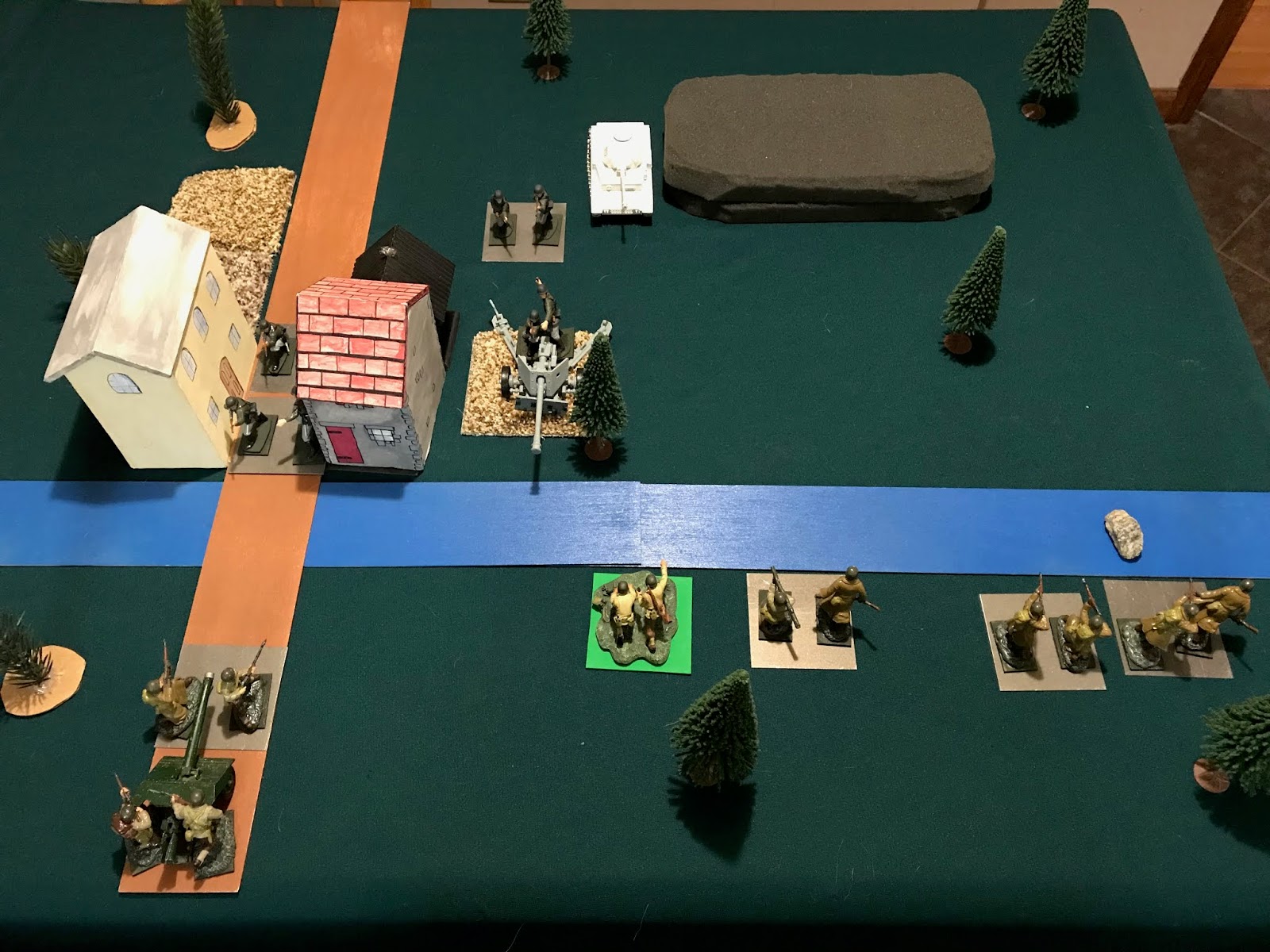
| Scenario 12: An Unfortunate Oversight. German deployment by my best guess, US by die roll. |
The results were mixed. Below I present a
post mortem of three of the changes: one of the failures, one partial success, and one complete success. It is lengthy and you are forgiven if your eyes glaze over and you move on to the next blog.
Close Assault
One of my biggest problems playing OHW WW2 is that very often, it devolves to the two sides firing away at each other in a battle of attrition. This would be acceptable, if boring, for WW1 trench warfare, but that isn't how I think of this period - there is motion, men scrambling through woods, stealing cover where they can, tanks grinding up the earth beneath their treads as the plow headstrong towards the enemy, etc.
 |
| Assaulting a tank, close or otherwise is risky business. |
One thing that helps create motion in OHW WW2 is to remember that units can either move or shoot, not both, in a turn. A lot of people, myself included, forget this.
This rule, I feel I should add, does not bother me - the very idea of rolling a die for hits in any WW2 game system is an abstraction of many bullets being fired. It's not hard to imagine that the units are always firing, but sometimes they are focused on maneuver and sometimes they are focused on doing damage (The
Paper Tigers ruleset really drove this point home for me). So if taking a terrain feature is the objective, a unit has to move - albeit at a leisurely pace as the 15 turn time limit is generally far more than needed. So, very often there is no benefit to closing on an enemy unit beyond the range of fire in OHW WW2 until the last few turns.
You could decide that "shoot" is the wrong term, and that the word is "assault" or something vaguer. Therefore, you don't need another mechanism, it just represents different things when in base to base contact. Except, close combat to take an objective seems more brutal and decisive in real life (or the movies for that matter), than sitting at a distance and firing away at an enemy position. And again, if it's the same effect, then there is no benefit, save being in a slightly better position to hold a terrain objective at game end, which, again, given the usual turn limits, isn't often an issue.
To address this, I decided I would add a close assault rule. A unit that ends its move in base to base contact with an enemy would be in close assault. Only infantry or tanks could initiate close assaults and the attacking unit would gain +2 to damage on the turn they moved into contact. That sounded good to me on paper, but the limitations of it came out in play.
 |
| The hill battle was a slug fest. |
In Neil Thomas's rules for eras in OHW that have melee rules, flanking makes close combat potentially devastating - double damage. Flanking is not possible in the WW2 rules because units have 360 degree field of fire. Relatedly they can turn as much as they want during their moves. The implication is that facing is irrelevant. So, if I'm not wrong about that interpretation, in the end, adding a +2 bonus was not enough benefit to make it worthwhile to close on an enemy.
A further negative is that infantry suffers a -2 against tanks, so close assaulting a tank merely removes this modifier on the turn they charge into close combat. Thereafter they fight at a disadvantage unless they break off and then try again. Unfortunately, this allows the tank to 1) attack them because they are still close assault (no +2 for the tank though, as they don't move into the combat) and then 2) blast the infantry after they move away to regroup for another assault. Finally, the tank, assuming it survives the next assault, gets another attack on the infantry. That's 3 casualty dice to 2 casualty dice.
Changing the 360 degree rule may make sense, but it may have other consequences I haven't thought of.
Limit How Many Units Can Activate
One of the things I like about games like
Company Command and
One Hour Skirmish Wargames is the limited ability to activate all your units just the way you want to. Being forced to make decisions about whether to make an assault with 1st platoon or maneuver 2nd platoon to be in a position to fire next turn make for interesting moments in the game in my opinion.
It's not that the other units are doing nothing of course - they may be keeping their heads down, they may be regrouping, they may be firing sporadically or calling in mortar support, for example. It just isn't relevant to you as the company commander. However, it allows for some narrative development - perhaps 1st platoon
suffers a lack of motivation or maybe they are taking heavy fire and
can't even lift their heads, it's up to you and how angry you are at them afterwards.
Since I like
Company Command (the only reason I haven't played recently is I want to build some smoke markers and some specific scenery / terrain items), I lifted the standard activation system there. Without giving too much away hopefully, I'll summarize it thusly: sometimes all of your units can fire, sometimes they all can move, sometimes half can move/fire. Except, as this is OHW, I changed the latter to move OR fire.
This has potential, but perhaps due to the scenario played, as well as my undoubtedly poor tactical choices, the result was half of the battlefield sat in stasis while the other half saw constant action. On the plus side, 15 turns may barely be enough to squeak out a win - activating no more than three units most turns results in some very quick turns. Getting to a terrain objective means potentially sacrificing weakening the enemy.
 |
| German units at start of game (there's one in the grey house). The ATG would never move. Neither would the infantry in the village until turn 8 or so. |
So, I think there is still something to this, but I would either go with the
Company Command basic method - either all move/none shoot or half move+shoot, or use a "pip spend" - roll a die and spend 1 pip per action, allowing infantry and tanks to both move and shoot in the same turn for 2 pips. Borrowing from OHSW, I could allow double moves an additional cost of 2 pips (so 3 pips to move 2x), but all movement must be completed before firing.
-
I suppose another option would be to roll to see if each unit follows its orders - allowing for the possibility that all,some, or none might activate - but that sounds like a lot of dice rolling for a similar effect.
Resupply
This isn't really a good name for this, but it's the name from the rules I
borrowed stole it from:
Pz8 Divisional WW2 rules. At the end of each turn, roll 1d6, on a 5 or 6, the side can remove 1d6 worth of hits from any units, either all from one or distributed across multiple units.This doesn't address any deficiency with the OHW WW2 rules, at least not in the way that I think most people would address it.
A frequent criticism of OHW is that there are no built-in morale rules.
Normally, I take this to mean, a side fights until there are no units remaining (although nothing in the rules actually requires a player to do so - they could order their troops to quit the battle at any time) rather than breaking if losses are suffered beyond point X. This rule does not address this issue. I play solo, and I am as likely to call off a battle when playing the game any further seems pointless as I am to fight until a single unit stands alone on the field, no matter how "unrealistic".
However, considering that the hits in OHW represent morale as well as injuries and casualties, treating "resupply" as an improvement in morale - and thus the staying power of a unit - makes perfect sense to me. Perhaps the platoon leader made an inspiring speech or maybe Pvt. Walker committed an act of bravery that inspired all those around him and it spread like wildfire.
Because it isn't guaranteed every turn, it is still a rapid play game, but it provides some excitement when one side is on the verge of losing a key unit and they miraculously get 6 points back just when they need it.
Conclusion
It wasn't a total failure, but the game I played was unsatisfying - perhaps even more so than playing RAW OHW. Maybe it was the hope I placed on the changes or maybe it was that I saw the game merely as a test bed.
All said, I'm not sure when or if I'll try further modifying OHW WW2. At this scale, 1 base = 1 platoon, commanding a company, I have other rules that require less effort to make fun for me.
Of the rules I have, I find Morschauser Modern works well for a rapid-play and "toy soldier" feel for this type of game - and it has brutal close combat rules. In fairness, I do feel the need to house-rule cover, probably with a saving throw as Ross Mac suggested in a comment in an older post.
For more chrome,
Blitzkrieg Commander could work, although this is a very small game for that, as could
Tactical Combat (somewhere between Morschauser and BKC on the toy soldier vs simulation scale), with the same caveat. At 1 base = 1 platoon, these games expect around a battalion's worth of units on the table
. Morschauser anticipates far more units on the table as well, but I have played it enough with just 6 units on the table to know that it's an enjoyable game that way.
The real benefit of all this is that it once again caused me to consider my WW2 games, what I want from them, and at what level I enjoy gaming this period, which is never a bad thing.