Saturday, August 15, 2020

Operation Citadel Campaign Begins

Having pushed past the initial defensive lines, Grossdeutschland found itself within a few kilometers of Cherkasskoye. The 199th Guards Rifle Regiment stood in their way.

Grossdeutschland advances headlong into the Soviet center - now with the regimental AT battery. In the background, the beans represent mined grid spaces.

The Soviets demonstrated an iron will to fight and only yielded ground after several hours of fighting. Two AT batteries of the 67th Guards Rifle Division reinforced what remained of the 199th. Grossdeutschland's Panzer regiment attacked the village from the west, while the Pioneer battalion flanked the village to the East. The Germans were careful to avoid the mine fields between the defensive works and Cherkasskoye.

The Soviet HQ surveys the scene : it does not look promising .

GD Pioneers overrun the 199th's regimental mortar battery before making an assault on the AT battery in the village.

The GD Pioneers fought their way into the village where fierce close fighting with one of the AT batteries went unexpectedly wrong.

The Regimental HQ survives in the village, but for how long?

Heavy artillery called in by the 199th's FOO attached to the Regimental HQ scattered II/PzGrenadier GD. Bogged down during the initial contact, Grossdeutschland's drive to the village had been delayed and at a significant cost. Despite the presence of two Panzer battalions on the outskirts of Cherkasskoye,  III/PzGrenadier was still a kilometer from the village and at risk from increasingly dialed in artillery fire; Grossdeutschland had run out of momentum and soon would run out of daylight.

To their relief, from the East, the tell-tale rumble of tanks and armored half-tracks grew louder; reinforcements from 11th Panzer Division were arriving.

***

You're probably tired of seeing this table set up. Me too! I'm ready to try the next scenario.

So, Friday night I decided that I would play for the campaign points with the Morschauser-fied version of my battalion-per-base grid rules. I also modified some things for the scenario - like I decided to forgo 11th Panzer's arrival as part of the game and instead this is just about Grossdeutschland's effort.

The game ended after 14 turns, with both sides having reached their break point (the Soviets had reached theirs several turns before the assault on the village itself began). 

For this game, I tried out the rule that units could move or shoot but not both in the same  (with assault counting as movement). Because I'm tracking hit points per unit, the units last a bit longer and the initial break through took a little longer than hoped. More artillery fire and more combined attacks on a single target could help there.

Because the Soviets held the village at the end, they were awarded 2 points for the win. In addition 50% of German units were eliminated, which gives the Soviet 2 additional points, for a total of 4.

The Germans failed to take the village but they did eliminate just over 80% of the Soviet regiment, for a total of 4 points.

At the end of the first campaign game, the campaign is a tie at 4-4.

Thursday, August 13, 2020

Add More Morschauser

 Rules tinkering continues.

After another dozen or so games played on the computer using Google Draw for the map and units, I learned quite a few things. I could go into a deep dive about what I found "wrong" with my recent rules attempts, but in short, they weren't Morschauser enough for me.

So, last night, I ran through a grid-based homage to Morschauser with an overall feeling that was just "better" to me.

The only thing I think the scenario needs now is some mine fields.

The now familiar opening moves of Cherkasskoye.

The Soviet middle melted away before the combined Panzers and PanzerGrenadiers of Grossdeutschland.

The Soviet left fell away shortly after. Effective Soviet ATG fire dealt a blow to the Panzers.

11th Panzer Division (the "Ghost Division") sends help [turn 9]. The Soviets are in an even tougher spot now.

A hard fought battle for the town ensued - including an accidentally suicidal assault by the Grossdeutschland Pioneer battalion which opened the way for Recon to advance.

After turn 8, I roll for how many turns remain and with a roll of 3 it was going to be tight. In the end, the Germans could not quite clear the entire village, although they managed a foothold. 

The Soviets suffered an overwhelming loss of units - because I kept going well past their break point. I'm not sure if that makes sense or not for the scenario. I kind of feel like it does, but the fact that it came down to the last turn, I feel, means they should get some additional credit.

If I scored this per Featherstone, it'd be 5-2 , in favor of the Germans (the battle was a draw, plus 1 point for every loss of 20% inflicted). However, given the Germans had to call on 11th Panzer, even if they never reached the village, to me, means the Soviets deserve some extra credit for delaying the German advance. I would score this 5-3 if this was for the campaign.

Like I said, I want to add mine fields, which, given the change in rules, seems a necessity to balance out the sides a little better.


Tuesday, August 4, 2020

I Am Not Good at Leaving Well Enough Alone

As an inveterate rules tinkerer, I decided to make some changes to my own grid-based battalion per base rules - particularly regarding effects vs armor (I didn't like that mortars could eliminate tanks). However, I made some other tweaks, that, frankly, broke the game in some respects during play testing.

So here are some pictures while I reset some of the changes. Please note, the game pictured does not count towards the campaign, although it is the Cherkasskoye, July 5, 1943, scenario I posted.

I/PzGr, and I and II/Pz advance up the middle, while Recon races up the road. All units encounter fierce Soviet resistance, but the Soviets on the German right collapse, opening the advance on that flank.

With their lines breached, the commander of the 67th Guards Rifle Division orders two ATG batteries to provide support for the 199th, as it falls back towards the town.

To say things don't look good for the Red Army is an understatement.

Another view of the same scene. This is my favorite picture of the night.

The Soviet side of the line.

I and II/Pz reach the village, swinging to the left flank, and engage in a shootout with ATG batteries (the 1st was destroyed by combined artillery and I/Pz fire)

Recon arrives on the right flank and I/PzGr advances in preparation to storm the town. (Yellow dice are my "Overwatch" markers. It did them little good,)

It was an overwhelming German win, and a victory for GrossDeutschland , as there was no need for 11th Panzer Division's support.

Friday, July 31, 2020

Operation Citadel Campaign Points Scoring

Ran through another play test of my Cherkasskoye scenario last night. I wanted to try out some things, but more importantly, Steve8 reminded me of Featherstone's approach to conducting a point-to-point campaign as described in Solo Wargaming. One difference is that there, the battles happen regardless of the outcome of any given battle being counter to history.

Soviet 199th Guards Rifle Regiment including the regiment's 1 medium mortar battery,  with 67th Guards Rifle Division AT Batteries that arrive as reinforcement.

But, what really struck me is how Featherstone's scoring method is *much* simpler than my convoluted approach and I think I'll be using it. Points for win or draw, and points for every 20% losses inflicted.

Armored panzer-grenadiers attempt to dislodge Soviet defenders. The defenders had already taken a battalion of the panzer regiment out of the fight.

I need to settle on a few points - such as, if the Soviets are completely eliminated but GrossDeutschland can't reach the village before game end, is that a draw? Or if the Soviets hold onto a part of the village (which is the way the game ended last night), is that a Soviet victory because the Germans didn't achieve the objective or should i call that a draw because they occupied the other village grid space?

A 67th Guards Division AT battery making use of captured PAK 38s.

On the one hand, it really doesn't matter. On the other, the idea with campaign points is to provide an extra layer of challenge for the player (me, but also anyone else who tries to play my scenarios) to achieve victories without unduly risking troops.

Wednesday, July 29, 2020

Operation Citadel: Point-to-Point Campaign : Cherkasskoye

I am playing through a solo point-to-point campaign of Germany's 1943, Operation Citadel, inspired heavily by this older post from the Flames of War website.

This is the first scenario - I have played and adjusted it over the course of a few dozen games. While it probably still needs tweaking, it has provided a fair number of exciting games for me and so, I'm sharing it here in case anyone else finds it useful. I'll post one of my own play throughs next time.

Scenario 1: Cherkasskoye
Date: 5 July 1943


Initial Report: On July 5, after breaking through the Soviet defensive lines encountered on their advance towards Cherkasskoye, GrossDeutschland, became embroiled in heavy fighting with the 199th Guards Rifle Infantry Regiment, 67th Guards Rifle Division, outside of the objective.

Objectives: GrossDeutschland is to capture Cherkasskoye. The 199th Guards Rifle Regiment intends to prevent that.

Turn limit: The turn limit is not fixed, fight until the combination of GrossDeutschland + 11th Panzer is exhausted (see Reinforcements) or Soviets are reduced to two on table units, at which point it can be assumed they abandon the fighting.

Setup: This game uses a small table representing an area approximately 6km by 6km, which in Division Squares is 6 spaces x 6 spaces. GrossDeutschland attacked on a 3km wide front at Bustovo [I have to find the source of this and credit it], so, while going wider than 6 squares may make the table seem less crowded, it is also arguably even less accurate.

German OOB:
Elements of 4th Panzer Army, GrossDeutschland (GD) Division

Division HQ
PanzerGrenadier Regiment GrossDeutschland (Veteran)
1 Armored Infantry Battalion, sdkfz 251
2 motorized infantry battalions, on foot
Pioneer Battalion GrossDeutschland (Veteran), sdk 251
Recon Battalion GrossDeutschland (Veteran), sdk 222
Panzer Regiment GrossDeutschland :
2 PzIV battalions
Artillery regiment GrossDeutschland
 2 battalions of heavy artillery (off-table)

Exhaustion Point: 5

Reinforcements:
Elements of 4th Panzer Army, 11th Panzer Division
Panzer Regiment
1 Battalion (PzIV)
(Optionally: Flammpanzer III)
PanzerGren.Regiment
1 Armored Infantry Battalion, sdkfz 251

Exhaustion Point: See Reinforcements Section

Soviet OOB:

Elements of 6th army, 67th Guards Rifle Division
199th Guards Rifle Regiment
Regiment HQ
3 Soviet Guards Rifle Battalions
1 82mm Mortar Battery
optional: minefields and barbed wire)

67th Guards Rifle Division Artillery
2 batteries of 122mm guns (off table)

Reinforcements:
67th Guards Rifle Division ATG Batteries
2 ATG batteries, towed

Exhaustion Point: 5

Table setup:
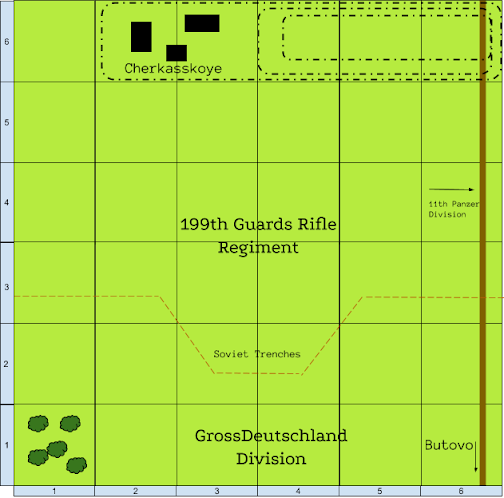
There is little to no cover available most of the table - the land is mostly scrub. Cherkasskoye is located on a plateau and should at the very least b
e on a hill. The example table map is an interpretation of the top center of the wonderful illustration of the battle of Cherkasskoye as appears in Kursk 1943: The Tide Turns East by Mark Healy.

Example table layout:


Deployment:
Soviet Rifle battalions must deploy in the trenches/defensive works, mortar and HQ can deploy anywhere.

Suggested deployment:
  • Deploy Soviet rifles in (2,3), (4,2), and (6,3) OR randomized Soviet rifle placement: number each trench space 1-6, then roll 1d6, place battalion in appropriate trench space.
  • Mortar battery in (3,3), HQ in (4,4).
  • All Soviet Rifle Battalions in trenches start in Overwatch.
GrossDeutschland starts off-table and has initiative each turn.

GrossDeutschland Artillery Barrage:

To reflect the inaccuracy of the maps - which left German officers unable to determine which were real and which were dummy units - albeit much later in the day than in real life, GrossDeutschland may make 1d3 artillery attacks prior to the first turn.

However these attacks must target one of the 6 grid spaces containing a trench/Soviet defensive work and are randomly determined by die roll. For each artillery attack, roll 1d6 - the attack is on the trench in the appropriate column. These do not count against the artillery available during the game.

Resolve each attack normally on any Soviet unit present in the space, if any.

Soviet Reinforcements:
The two ATG guns provided by the division may be brought onto the table any turn after GrossDeutschland has broken past the Soviet trench line, or after turn 4, whichever comes first. They may enter the table from (1,6), (2,6), (3,6), or (4,6) provided the space is not occupied by an enemy unit

German Reinforcements:
At the end of turn 8, if GrossDeutschland has not captured the village or after a turn where GrossDeutschland has become exhausted 11th Panzer Division replacements arrive in column 6 (see map).

Roll 1d6 for row (See map).
Regenerate the German initiative deck to match the new force’s strength and reset their exhaustion point.
Roll 1dAvg. The result is how many turns GrossDeutschland + 11th Panzer Division have remaining to capture Cherkasskoye.

Historical outcome: GrossDeutschland was dealt heavy losses and their advance into the village was slowed, until 11th Panzer Division, on their right flank, sent reinforcements (including flammpanzer III’s). At which point, the GrossDeutschland Pz. Gren. were able to drive the Soviets from what remained of Cherkasskoye.

Suggested Campaign Scoring:

  • Holding Cherkasskoye at the end of the game, with at least one unit and no enemy units present in the village spaces: 10 points
  • If both the Germans and Soviets have a foothold in the village at game’s end : 5 points for the Soviets
  • Every enemy unit eliminated : 2 pts (3 pts for veteran units)
  • If GrossDeutschland reaches their exhaustion point : 5 points for the Soviets
  • If 11th Panzer + remaining GrossDeutschland also reaches their exhaustion point : 5 points for the Soviets
  • If a GrossDeutschland PzG unit is holding the village at end of game : 5 points
  • If the village is cleared by German artillery but no GrossDeutschland unit in village at game end : 5 points Soviets
  • If GrossDeutschland captures the village before they reach their exhaustion point (and before reinforcement) : 5 points Germans
  • If GrossDeutschland (Before reinforcement) causes the Soviets to each their exhaustion point : 5 points for the Germans
Next: If the Soviets lose, the next battle is Syrtsevo. If the Soviets outright win, the next battle should be GrossDeutschland again trying to wrest the village from the Soviets, both sides will likely receive reinforcement. If the Soviets win again, the invasion is called off.

Scenario Design Notes:Please note, the scenario is written for own toy-soldiery Division Squares, and as such, it may require adjustment for other rules.

It hopefully has been designed so the Germans will win more than half of the time, if relatively well commanded (in my play tests, I played quickly and often made errors in judgement that cost the Germans substantially). However, a poorly commanded German force will lose. As this is intended as a solo campaign game, to make the game more interesting, the Soviets (non-player) can well come away with the same or more points towards a campaign victory than the Germans (player), even if they are forced to abandon the village.

Elements of GrossDeutschland awaiting deployment.

Friday, July 24, 2020

Rumors of My Demise and a Developing Set of Rules

I am deeply humbled. I disappeared and did not consider that during the times of the pandemic that this might cause concern.

Just before the US plummeted into lock downs and rising COVID infections, I found myself being called to return to music (I mean my own music. I'm in a band but I don't do much writing for it). Music, like wargaming, can demand a ton of time, but unlike gaming, drains me of energy in all sorts of ways. The creative process, for me, is not an enjoyable stroll in the park but the tearing of some hideous thing from the purple-black tendrils of doubt and pretension, hurling the putrid sputtering mass into this reality, and wrestling it into something less horrible, through the power of blood and sweat and tears, presumably for sharing with the world. The latter opens up gaping dimensions of doubt unknown to those who have never walked that path.

But I digress. The point is, writing and recording sucks up free time and I am terrible about balancing my interests.

I returned to gaming in June however with a handful of G Company games, including revisiting D-Day with the US Army's 1st Infantry Division. Some thinking about what I wanted from my games led me back to company element games, and then some more reading led me to battalion element games with a goal of playing GrossDeutchsland's advance during Operation Citadel (more to come on that, including five scenarios with painfully simple maps made in Google Draw, suggested orders of battle, etc.).

It may be hubris speaking, but this reminds of me of the pictures in older war games books. Please note the card stock buildings are prototypes, and not finished. I wanted to make collapsible Russian style buildings. They work, I just need to make more and finish them.

As an apology for disappearing without so much as a word, allow me to present a draft of what I call Divison Squares (I was calling it Space Wars early on as a joke, because that implies outer space and perhaps even Star Wars, when it's not about that at all. Which tells you all you need to know about my sense of humor.) There is nothing new in there, just an amalgamation of mechanisms that work for me, written for me, but now cleaned up a bit in case anyone else finds use in them.

The Division Squares rules began as Battalion Squares where each unit is a company. I'll revisit those eventually. This picture is an early game using those - hence the mixed heavy weapons company for the Germans.
Although I have played them for at least two dozen games, there are still things missing and it's a living document (for instance air-to-ground rules are missing, as are mine fields. Both of which will be added eventually). These are intended for playing WWII on a grid with a regiment to a division+ per side in a smallish space.


A German divison (GrossDeutschland in the scenario, but could be a generic Panzer Division) advancing against a Soviet rifle regiment (199th but could be any) in trenches- one tank unit has already been destroyed (off camera bottom right). There are three scales of vehicles in this picture, for those following along at home.

They work for One Hour Wargames scenarios as well, at least in my limited tests (mostly I've been playing GD at Cherkasskoye - a table layout and scenario based on a historical battle.) However, expect most OHW scenarios with OHW sized forces to play in about 8-10 turns (not unlike OHW rules in my experience).

From a OHW scenario. I adjudicated the game, but little monkey (he's 8, so maybe not so little) controlled both sides.
 Please accept them in the spirit they are intended.

Thursday, March 5, 2020

1/43 Madness

I recently decided to check out 1/43 vehicles (hence the title) for my wargaming needs. A lot of vehicles just aren't available for the larger figures except in 1/35 model kits and I am not a model builder (I have little patience). Classic Toy Soldiers offers a very limited range of vehicles in 1/38. Those that are availabled in 1/50, are die-cast and cost an arm and a leg to ship to the States. While1/43 vehicles are delicate like 1/35 models, there is quite a variety avaialble, and they cost closer to toy vehicle prices.
 
Motorpark.
The Sdk. 222 looks good in this group, but is tiny compared to my 1/38 tanks (works fine with my 1/48 - 1/50 tanks, but I can't afford a t-34 in 1/50, let alone three or more of them. 1/43 is possible but I already have 1/38) . It's even small next to the Detail kubelwagen. I may mix scales when fielding a recon battalion - 1/32 armored car, 1/32 kubelwagen, 1/43 everything else..


Motorized infantry.
The above illustrates how the vehicles scale with the figures.

I could easily fit this combination into a 6" square with space left over, or with the infantry side by side but less extra room, for grid games. Placing the vehicle behind or next to infantry/guns facing forward or backwards could indicate statuses - like infantry embarked, gun deployed, etc, in non-grid games.

 Here's what the same vehicle looks like next to a CTS 1/38 PZ. IV .

Eastern Front German vehicles.
This works pretty well to my eyes - minus the windshield falling over on that half-track because it broke within a day (I did say they were delicate, right?). The transports will function more like markers in my games - they aren't units in and of themselves - and thus don't need to dominate the landscape.